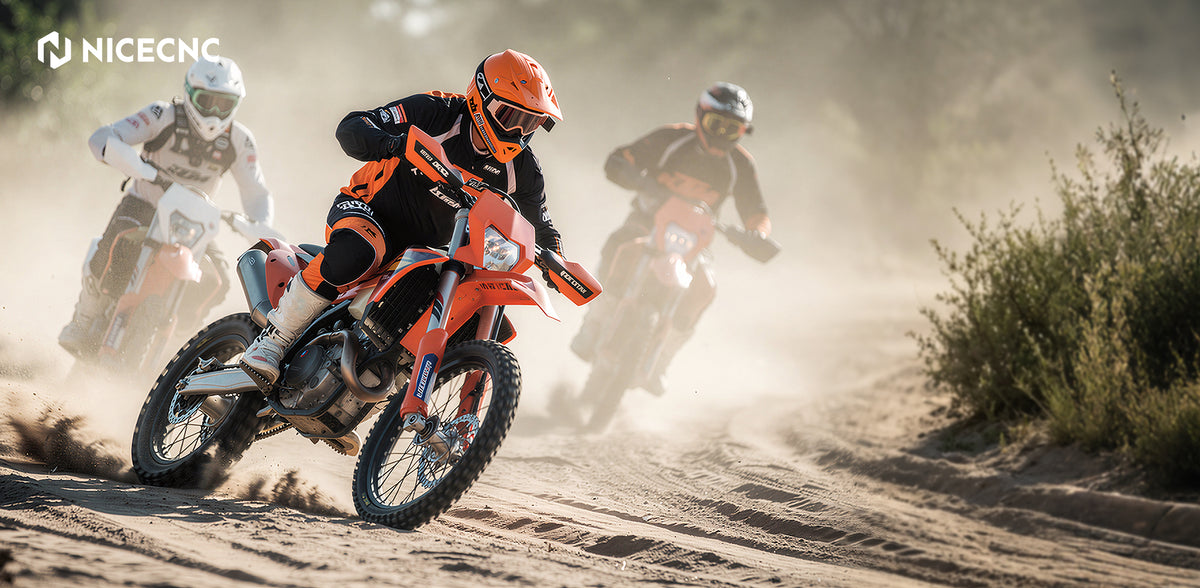
Ask ten riders whether a 2-stroke or a 4-stroke is better and you may get ten different answers. That is not because the question is impossible. Most riders are simply answering for their own terrain, pace and habits.
A rider picking through wet roots at walking speed wants something very different from a rider trying to repeat clean motocross laps. One may value a bike that is easy to place and quick to recover when the line goes wrong. The other may care more about steady drive and predictable traction.
So the useful question is not “Which engine is better?” It is:
Which engine makes your kind of riding easier?

A 2-stroke is usually the stronger starting point when you want a lively response, a light-feeling chassis and relatively simple top-end engine work. A 4-stroke generally suits riders who prefer steady drive, stronger engine braking and a broader, more predictable delivery.
That is only a starting point. Displacement, gearing, engine tuning and the bike’s intended use can matter just as much as the number of strokes.
2-Stroke vs 4-Stroke at a Glance
| What matters most | Usually favors |
|---|---|
| Tight, technical trails | 2-stroke |
| Hard enduro and repeated obstacles | 2-stroke |
| Quick direction changes | 2-stroke |
| Simpler top-end engine work | 2-stroke |
| Smooth, repeatable traction | 4-stroke |
| Fast, flowing terrain | 4-stroke |
| Stronger engine braking | 4-stroke |
| Beginner-friendly performance | Model matters more |
How 2-Strokes and 4-Strokes Feel Different

Power and throttle response
A 2-stroke usually reacts quickly when the throttle opens. The engine gains rpm fast, and a small clutch input can make a noticeable difference. That is useful when you need to lift the front wheel over a root, correct your line between rocks or restart a climb before the bike loses all momentum.
The old stereotype says every 2-stroke has a sudden, difficult powerband. Smaller motocross bikes can still reward high rpm and careful gear selection, but modern enduro machines have changed the picture. Current 250cc and 300cc 2-strokes can pull cleanly from low rpm, and injected models such as the KTM 300 XC-W are designed to keep fueling consistent as conditions change.
A 4-stroke normally builds drive in a steadier way. It often carries a gear for longer and asks for less clutch work on flowing terrain. The power may feel less dramatic, yet it can be easier to repeat corner after corner. That is one reason a fast rider may be going quicker than the engine feels.
Traction and engine braking
A 4-stroke tends to feel connected to the rear tire. When grip is available, it produces a steady push rather than a rapid change in character. Closing the throttle also creates more engine braking, which some riders use to settle the bike before a corner or control speed on a descent.
A 2-stroke generally rolls more freely when the throttle closes. The chassis can feel light and active over rough ground, although the rider may rely more on the brakes for speed control. Riders who switch engine types often need a few hours to recalibrate; familiar inputs suddenly produce a different response.
Handling and fatigue
Scale weight matters, but it is not the whole story. Engine inertia changes how willingly a motorcycle leans, turns and recovers from a mistake.
In slow terrain, a 2-stroke often feels easier to pivot, lift or move across the trail. A 4-stroke may need more effort in those moments, then repay the rider with a calmer, more settled feel once speed rises.
Maintenance: Simpler Is Not the Same as Maintenance-Free
The usual summary is that 2-strokes need more frequent work but cost less to rebuild, while 4-strokes run longer and become expensive when something fails. There is some truth in that, but it is too crude to use as a buying rule.
Usually simpler inside the top end
- Fewer major valvetrain components
- Top-end service is generally more straightforward
- Fueling and lubrication system vary by model
- Air-filter care remains critical
More components, more variables
- Valves, camshafts and timing parts add complexity
- Oil condition and valve clearance matter
- Some trail use may allow longer internal-service intervals
- Major cylinder-head work is usually more involved
Actual cost depends on how the bike is used. A competition 250F that spends its life near the rev limiter is not comparable to a gently ridden trail bike. The same applies to a 2-stroke that is raced hard, run with a dirty air filter or left too long between inspections.
There is no responsible universal piston or valve-check interval. Start with the manual for the exact model, then adjust for dust, heat, racing hours and how aggressively the engine is used.
Which Engine Works Better for Your Riding?
Rocks, roots, ledges, failed climbs and sharp direction changes.
Open trails, cross-country sections, long corners and repeatable laps.
Tight trails and hard enduro
A 2-stroke makes a strong case when the route is slow, awkward and full of interruptions. The rider may need to lift the front wheel with little warning, change lines in half a bike length or recover after a failed climb.
This is where bikes such as the KTM 300 XC-W, Husqvarna TE 300, GasGas EC 300 and Beta 300 RR make sense. The reason these bikes suit the terrain is not simply peak power. It is the combination of low-rpm pull, quick response and a chassis that feels willing to move when the original plan stops working.
A 4-stroke can still be excellent in technical terrain, especially for riders who prefer calm traction and measured throttle inputs. It usually asks for more effort during sudden direction changes, but some riders consider that planted feel a benefit rather than a drawback.
Fast trails and cross-country
When the trail opens, a 4-stroke often becomes easier to live with. Broad power lets the rider hold a gear, build momentum and concentrate on the ground ahead instead of constantly managing the clutch.
The Yamaha YZ250FX and WR250F sit on the lighter 250-class side of that choice. The KTM 350 EXC-F, Husqvarna FE 350 and Beta 350 RR add more torque without carrying the full character of a 450. They may feel heavier in a tight turnaround, yet calmer over a long, rough straight.
A 2-stroke still suits riders who enjoy an active style or expect the trail to turn technical without warning. The difference is rhythm: frequent small corrections versus steady drive.
Motocross
Modern 250cc four-strokes such as the Yamaha YZ250F, Honda CRF250R, Kawasaki KX250, KTM 250 SX-F, Husqvarna FC 250 and GasGas MC 250F are built around repeatable drive. They can carry speed through a rut without forcing the rider to chase a narrow rpm window.
A Yamaha YZ125, YZ250, KTM 125 SX, KTM 250 SX or Husqvarna TC 250 gives the rider a more involved job. Gear selection, clutch control and momentum matter more. When the timing is right, the bike feels light and urgent. When it is wrong, the mistake is obvious.
A 4-stroke often makes consistent laps easier. A smaller 2-stroke can reward precise momentum, clutch control and gear selection.
Beginners
“Buy a 4-stroke” is not enough advice. A mild trail 4-stroke can be easy to learn on; a race-focused 450F is not beginner-friendly simply because it uses four strokes. A 125cc 2-stroke may be manageable in outright power, yet it asks for more clutch use and shifting than many new riders expect.
A beginner should prioritize manageable power, appropriate physical size, predictable response, suitable suspension and realistic maintenance. The right motorcycle matters more than the supposedly easier engine type.
Displacement Comparisons That Actually Help
125cc 2-Stroke vs 250cc 4-Stroke
The 125 needs rpm, clutch work and accurate gears. The 250F usually offers more usable drive across a wider range. The 125 rewards precision; the 250F is easier to ride consistently.
250cc 2-Stroke vs 250cc 4-Stroke
Equal displacement does not mean equal character. The 250 2-stroke feels stronger and more immediate; the 250F delivers power more progressively and can be easier to connect to the ground.
300cc 2-Stroke vs 350cc 4-Stroke
The 300 2-stroke usually suits slow, technical and obstacle-heavy terrain. The 350F often makes more sense for flowing enduro, long rides and riders who prefer a broader, calmer delivery.
These are common use-case comparisons, not exact horsepower equivalents.
Which One Should You Choose?
Lean toward a 2-stroke when…
- Your trails are tight, steep or technical.
- You frequently cross rocks, roots and logs.
- You value quick direction changes.
- You enjoy active clutch and throttle control.
- You prefer less engine braking.
- You want relatively straightforward top-end work.
Lean toward a 4-stroke when…
- You ride fast, flowing or open terrain.
- You prefer smooth, repeatable traction.
- You like holding a gear rather than shifting often.
- You use engine braking to control the bike.
- You value stability under acceleration.
- You often ride long sessions.
Think about the hardest part of your normal ride. If you fight the bike to move, pivot or recover it, the 2-stroke side deserves a closer look. If you fight to keep the power calm and the rear tire driving, a 4-stroke may solve more of your problems.
Final Verdict
A 2-stroke is not automatically faster, cheaper or harder to ride. A 4-stroke is not automatically smoother, more reliable or better for beginners. Those descriptions only become useful when they are connected to a specific bike and a specific type of riding.
For tight technical trails and hard enduro, a modern 250cc or 300cc 2-stroke is difficult to ignore. For fast trails, cross-country riding and repeatable motocross laps, a 250cc or 350cc 4-stroke may ask for less attention and save more rider energy.
The better dirt bike is not the one that wins the engine argument. It is the one that makes your terrain easier without creating an ownership experience you do not want.
Frequently Asked Questions
Is a 2-stroke or 4-stroke better for beginners?
A mild, correctly sized motorcycle matters more than the engine cycle. A trail-oriented 250cc 4-stroke is often easy to learn on because the power is predictable. A 125cc 2-stroke can also work, but it asks for more clutch use and gear changes. High-performance 250cc 2-strokes and 450F race bikes are usually poor first choices.
Is a 2-stroke dirt bike faster than a 4-stroke?
Not necessarily. A 2-stroke often produces strong performance for its displacement, while a larger 4-stroke may make more overall power and transfer it to the ground more consistently. Rider skill, terrain, gearing and displacement matter more than the number of strokes alone.
Which costs less to maintain?
A 2-stroke top end is generally simpler and uses fewer major components. A 4-stroke may go longer between some internal services in certain trail use, but valvetrain and cylinder-head repairs are usually more involved. Real cost depends on the model, riding intensity and maintenance quality.
Is a 2-stroke better for trail riding?
A 2-stroke often suits tight, technical trails where quick response and easy direction changes matter. For fast, flowing or long-distance trails, a 4-stroke’s steady traction and broad delivery may be less tiring. “Trail riding” covers many different conditions, so terrain should decide.
Should I buy a 300cc 2-stroke or a 350cc 4-stroke?
Choose the 300cc 2-stroke for tight terrain, repeated obstacles and a more responsive chassis feel. Choose the 350cc 4-stroke for flowing enduro, longer rides and predictable traction across a broader rpm range. Both are capable; the terrain and your preferred riding rhythm should make the decision.
What 2-stroke and 4-stroke parts can I buy from NICECNC?
NICECNC offers model-specific parts for many 2-stroke and 4-stroke dirt bikes, including protection, controls, drivetrain, braking, cooling and chassis components. Availability varies by platform, so confirm your make, model and year on the collection or product page before ordering. For fitment help or product recommendations, contact us through Inbox or email us at support@nicecnc.com.
Sources
These links support specific technical or model examples in the article. The analysis, comparisons and recommendations are independently written.
- KTM 300 XC-W Hardenduro — official technical specifications
- Honda CRF250R — official engine and chassis features
- Yamaha YZ250FX — official model announcement and features
- Beta 300 RR X-Pro — official model page
- Husqvarna TE 300 Pro and FE 350 Pro — official 2026 release
- Hero photograph by Claudio Segovia — Pexels source and license page
- Riding photograph by Selma DA SILVA — Unsplash source and license page